
#175 Lady Ludd
Sophie Huckfield
06-28 Sep 2025 12-6pm Thu-Sun or by appointment
Sophie Huckfield is an artist, designer and writer. They draw on archival and research materials to co-produce multidisciplinary artworks which move between video, repurposed tools and sculpture, audio-visual installations and writings. They are currently Stanley Picker Fellow at Stanley Picker Gallery (2024/25). They perform and DJ as Lady Ludd.
Lady Ludd re-situates the 19th Century Luddite movement within a contemporary intersectional feminist lens, through the repurposing of an historic loom into an electronic musical instrument. Working with sonics, craft and performance the exhibition seeks to question, subvert, and repurpose our tools as a means to challenge current narratives around technology and progress.
As the world grapples with ethical concerns around automation, AI, and the continued exploitation of the environment and human labour, this exhibition aims to convey an alternative narrative, exploring how communities have historically co-opted and redefined the tools of labour into instruments of agency. Revisiting the history of the Luddite movement through a queer, feminist lens, invites us to reconsider what resistance is and how repurposing has always been a feminist means of survival and imagination.
The Luddite movement emerged in England during the early stages of the Industrial Revolution and the harsh economic climate of the period, which saw a rise of difficult working conditions in the emerging textile factories. Luddites objected primarily to the rising implementation of automated textile equipment, threatening livelihoods and reducing the quality of goods sold.
The history of technology and labour is intimately entwined to the textile industry and the Luddites smashed machinery ‘hurtful to commonality’, such as the Stocking Frame, Power Loom and Spinning Jenny, as a form of protest, in conjunction to a letter writing campaign and public protests and marches. Rather than passively accepting the loss of their jobs, workers formed to rebel against the existing order.
They were named after the mythical figure ‘Ned Ludd’, who, according to legend, smashed two stocking frames in a fit of rage. When the Luddites emerged in the 19th Century, Ludd’s identity was appropriated to become the folkloric character of Captain Ludd, King Ludd or General Ludd, the Luddites' alleged leader and founder. The Luddites harnessed local folklore to craft a mythical identity which represented their plight and gave them a leader in which to anonymously and collectively sign off as. This fictional identity is still remembered to this day, but more importantly as a collective identity.
An unsung advent of this collective identity is Lady Ludd. Historical examples of Lady Ludd include women who incited food riots and frame smashing in the name of the Luddites, to male identifying Luddites disguising themselves as Lady Ludd in order to avoid identification.
“Conflict and struggle were… the occasion for some “gender trouble”, that is for the challenging of the traditional frontier between the sexes. The atmosphere of carnival and disguise offered convenient ways to reduce the responsibility of the rioters” (Jarrige, 2013).
Lady Ludd was of many genders and taking on the mantle of Lady Ludd consciously explored gender performance and fluidity for a range of aims, many in relation to direct action. Beyond the overt acts of protest, women in the movement also played pivotal roles in community organisation and solidarity. From gathering intelligence, warning fellow Luddites of impending threats, to forming support networks for families affected by the unrest.
There is very little feminist and queer critical analysis into this aspect of the Luddites. It is imperative that the role of women and queer people within this movement is no longer sidelined.
The exhibition explores these histories from a feminist and queer perspective, seeking to shed light on how women, non-binary and queer people’s version of the ‘break’ is often through “reclaiming, rearranging, repurposing and rebirthing” (Legacy Russell) the tools and technologies accessible to them, towards strategic survival and disruption.
In East Anglia the rapid implementation and mechanisation of work processes led to many rural textile and agricultural workers flocking to the cities to find work in the new textile factories, causing labour shortages, this led to extensive rural rioting and machine breaking in East Anglia from 1816, with workers rioting as well as sabotaging the mole plough and the threshing machine. This further escalated into the Swing Riots in 1833, with their mythical collective identity of: Captain Swing, workers adopted the same tactics as the Luddites and were arguably the most successful form of machine breaking protest following the Luddites movement and eventual crushing by the government and the military.
Historically, labour conditions have also developed counter cultural movements and new forms of creative expression – in particular musical movements, these creative movements became a way to express opposition to working or living conditions and the Luddites wrote and performed ballads to express their struggle. Sophie Huckfield with music technologist Dr. Juan Martinez Avila and maker Rosie Deegan, have transformed a historical loom – a tool of predominantly historic feminised labour – donated by the Framework Knitters museum, into an electronic musical instrument using contemporary tools, to be played by Lady Ludd in her multitude of guises. Through the act of collectively re-appropriating a machine into a tool for sonic experimentation, the artwork aims to dismantle binary systems and explore how technologies can be queered or redefined through feminist approaches.
There is still much to learn from the Luddites and through a feminist and queer reframing of these histories, we can begin to take these lessons and apply them to the contemporary context, in order to cultivate a critical questioning of the narratives we are given and to create alternative visions of making and labour relations. As our rights as workers are increasingly rolled back and the implementation of new technologies are projected to displace many workers – with women and migrant workers impacted the most – how can Lady Ludd explore new forms of resistance or expression? How can we reframe histories of the Luddites for the present day?
Through reframing these narratives, the exhibition aims to build new understandings of Luddism in order to collectively manifest a contemporary intersectional feminist Luddism for now and in the future, and to question how technology is implemented and for whom.
Lady Ludd has been supported by Broadway’s Near Now Fellowship using public funding by Arts Council England, The Sound and Music Charity and OUTPOST gallery.
Artist and Sound Composition Sophie Huckfield
Curator Rae Jones
Creative Producer Lee Nicholls at Near Now
Music Technologist Dr Juan Martinez Avila
Loom Stand Rosie Deegan
Costume Weavings Ann Seals and Sarah Cooke
Costume Design and Fabrication Molly Bonnell
Stage Design and Fabrication Tim Hattrick and Sophie Huckfield
Thanks to The OUTPOST Team, Lee Nicholls, Juan Martinez Avila, Rosie Deegan, Rae Jones, Tim Hattrick, Molly Bonnell, Sarah Godfrey, the Framework Knitters Museum, The Notts Guild and District of Weavers Spinners and Dyers, Ann Seals, Jon Flint, Lorenzo Prati, Laura Moseley.
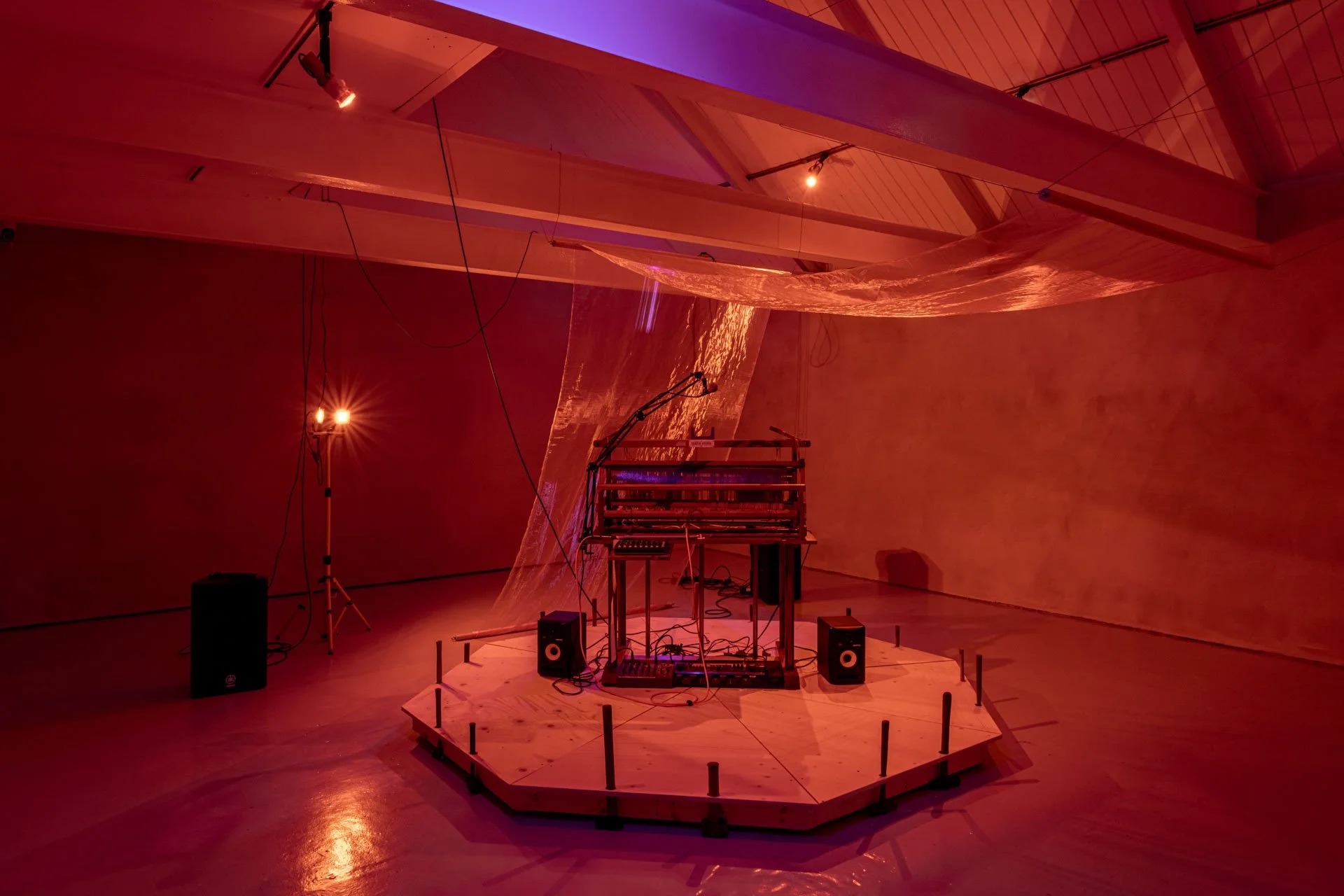
Image by Gillies Adamson Semple